
To AI or not to AI
Imagine: you’re reading a book, a thriller. A real page-turner. The author has a smooth writing style, every chapter ends with a cliffhanger, and the story is skillfully constructed with multiple layers. The characters are vivid and believable. The story is surprising and contains a few strong plot twists. You talk about it enthusiastically with a colleague, and he tells you that the book was written entirely with AI.
“Oh.”
How would you respond? Do you now have less appreciation for the writer? Or for the book? And do you think: “Right, I can do that too!”
But now imagine that you are the writer of this book. You know you’ve delivered a strong novel, but can you also be proud of it? Although most of the text was generated, it was your prompts that led to this result. You selected the generated scenes or had them regenerated when you weren’t satisfied and felt it could be better. Again and again. You made the choices from the options that AI offered you in developing the plot and the characters. It was your eye for quality and your sense of storytelling that led to this result. Another writer, using the same AI, would not have written nearly as good a book. Yes, you can certainly feel proud.
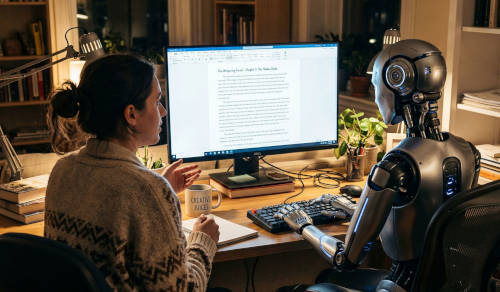
But did it also give you satisfaction, this non-traditional way of writing? Your role has changed, that’s beyond doubt—but in what way? Sometimes, while writing, you felt more like a manager than a writer; at other times more like an editor, sometimes like a judge in a writing competition. But rarely did you feel like a writer throughout the whole process. Even though that was your ambition, right?
The breakthrough of generative AI to the general public is only three and a half years old, and its development is charging ahead like a runaway train. No one—not even the experts—can predict how this will change our society. Maybe the technology attracts you, maybe it repels you. But whichever way you look at it, it’s hard to ignore.
Am I allowed to use AI?
From the example in the introduction, the question arose: how do we evaluate creative work that is fully or partially generated by AI? Do we condemn the use of AI, and if so, why or why not? A difficult question. I prefer to judge a book on its own merits—without knowledge about the author or how the book came into being. In short, for me the result is what counts, but that may be different for you. Maybe you consider an author’s use of AI to be cheating. Maybe you condemn it the way you condemn plagiarism—or a ghostwriter.
A frequently heard criticism of generative AI is that it has been trained on the work of renowned writers, without their permission or any financial compensation. The message is that in the sentences generated by AI, the voices of thousands of exploited authors can be heard. I think there is a kernel of truth in this, but for me this argument is not decisive in judging whether you are allowed to use AI for writing your book.
Another criticism concerns the damage to the environment and the climate. Chatting with AI consumes a great deal of electricity. Enormous models, tens to hundreds of gigabytes in size, perform a ridiculous amount of calculations to generate an answer for you. And often you have to ask your question again, slightly differently, to get a better result. The success of AI has led to hundreds of billions of dollars being invested at a rapid pace in building new data centers for AI. Do you, as a writer, want to contribute to this development? Personally, I am sensitive to this argument, but it does not (yet) stop me. I chat with a guilty conscience, and I look for smaller, specialized models that I can run locally on my computer.
So again: am I allowed to use AI? And if I use it, should I mention it somewhere? At the moment, my opinion is: yes, a writer may use AI. Should they also disclose this to the outside world? Not necessarily. What matters to me is that a good book is written—one I can enjoy as a reader. Of course, my opinion may change with new insights and developments, but this is how I currently see it.
Do I want to use AI?
I think you are allowed to use AI. But do you want to?
Whether you like it or not, it has become difficult not to use it at all. If you use an online spellchecker, there is already a good chance you are (indirectly) using AI. And the same goes for many tools: if you have your text read aloud by a tool, if you dictate your text, if you have a document summarized for your research, if you have your book cover generated, if you translate a piece of text from a foreign language—you are using AI.
“Yes,” you might say, “but that has nothing to do with my text—I write that myself.” That’s true. But with some tools, the line quickly becomes blurred. For example, if your spellchecker not only suggests language corrections but also stylistic changes. Or if you have your synopsis reviewed by AI and ask whether it has ideas to make the story more exciting, more romantic, or funnier. Or if you ask it to review a chapter. The AI will be very helpful and, after its review, it will suggest to rewrite the chapter for you. Who can resist?
And if you get very enthusiastic, you may soon have it generate scenes for you. But does your voice still come through in the text? Does it still feel like something you could have written? Or does that not matter to you, and is it simply about having a good text? Do you refine it afterward?
Whether you want to use AI for writing your book is something everyone must decide for themselves. But if you do use it, be aware of what it does to you. Do you still get satisfaction from the creative process? Should you use AI a little less—or perhaps a little more? What role do you assign to AI, and are you comfortable with that? Is it your co-author, your writing coach, or your source of inspiration that helps you through difficult writing periods? And is AI capable of fulfilling that role properly for you? All interesting questions—questions you can only answer for yourself in one way.
‘To AI or not to AI’ is not the right question. “How much AI?”—that is the question!